
What’s the difference between copyediting and proofreading?
Many people understand them to mean similar things, and they use the two terms interchangeably.
And when prospective clients email me, I always like to see whether their subject line mentions ‘copyediting’ or ‘proofreading’. Turns out it’s a pretty even split!
But two main factors set proofreading and copyediting apart: which stage of the production process your manuscript is currently in; and the kind of attention it demands from me as your editor.
Copyediting focuses on your final draft during the production process; proofreading focuses on your final document at the end.
Also, copyediting is about improving the expression of your writing; proofreading is about improving the presentation of your writing.
A quick summary of the editorial production process
Written academic work typically goes through several key stages, overseen by different people:
- Drafting (you, and your co-authors if it’s a collaborative project)
- Feedback (from supervisors, reviewers and peers)
- Revising the text in response to feedback (you/your co-authors)
- Copyediting (me, your copyeditor!)
- Design and formatting (you, or a designer you or your publisher commission)
- Proofreading (me, your proofreader!)
- Incorporating the final changes from proofreading (you, or your publisher)
- Printing, or final electronic output, such as PDF, EPUB, etc (you, or your publisher)
Here is a super simplified flowchart I just drew:
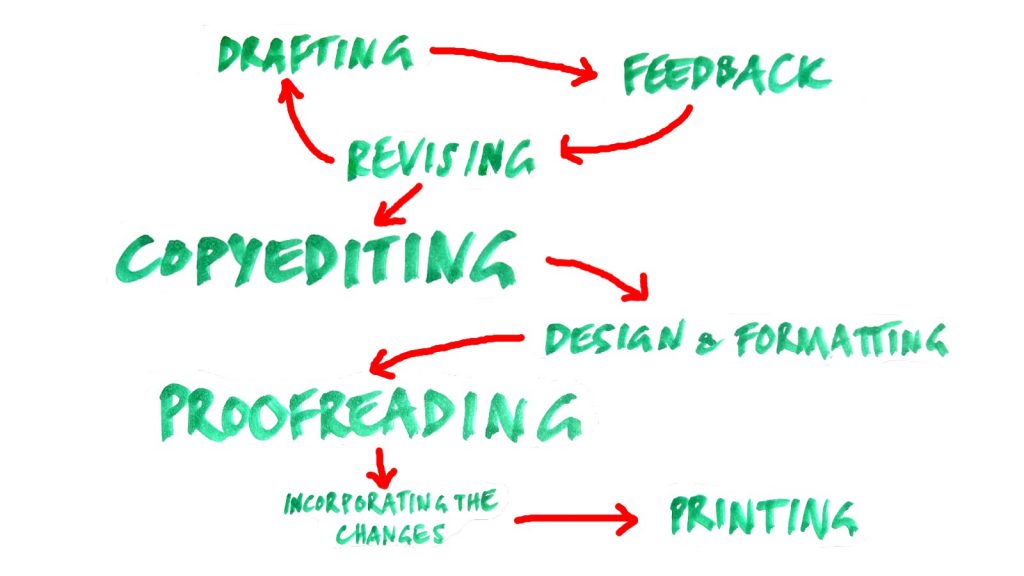
The first feedback loop focuses on your substantive argument: what you’re saying, and how you’re going to organise it on a thematic level, in chapters and sections. This is structural editing, and I don’t do it – for ethical reasons. To maintain your academic integrity, you and your feedback team need to do these early revisions independently.
What’s copyediting, then?
Copyediting operates at the sentence and paragraph level of your text. When I copyedit, I focus closely on the meaning of your words, and how they flow and connect.
You’ve been researching, drafting and redrafting for a long time. You’re immersed in your topic. But as a copyeditor, I’m coming in fresh! So my Editing Eyes are always searching for ambiguous, vague or confusing phrasing that might seem okay to you because you understand your topic inside out. Your reader doesn’t – yet!
A lot of my edits focus on sentence structure and and punctuation, because this is how you create the rhythm and tone that produces your unique voice.
Think of punctuation like the pauses in your speech, or the facial expressions and hand gestures you make. It’s not just a mechanical way to be ‘correct’ – it also makes your writing easier and more enjoyable to read.
Second, my copyediting showcases your argument, exhuming it from any vague, passive phrasing.
I organise your sentences so they’re grammatically active, and your reader doesn’t have to break their brain to figure out what’s happening in each sentence, and who or what does or causes that action. I front-load your sentences with these key actions and agents, so all the other details snap into focus.
As I edit, I flag any unclear spots in the text. But I don’t choose an interpretation for you, because it’s your project. Instead, I give you options, so you can figure out how best to express what you mean.
I’ll leave lots of comments along the lines of:
- “The word you’re using has connotations that don’t seem to match the way you’re using it. Here are some alternatives…”
- “When you write ‘various elements’, what are these? And what are they elements of?”
- ’Who or what do you mean by ‘they’ here?”
- “I notice you included [this word] as a keyword in your abstract – will your audience be familiar with the disciplinary context you’re using it in, or could you add a few extra words here to explain more?”
Third, copyediting tightens up your text so you get to your point quickly rather than wasting words on long, slow ‘build-up’ phrases, or too much repetitive introduction and summary.
Finally, copyediting is also about creating a consistent style for spelling, capitalisation, numbers, italics, and loads of other phrasing and formatting choices. When I copyedit, I create a personalised Editing Style Notes document just for your project. That way, you and your collaborators, supervisors and designers can refer to it, even after I’ve finished my edit.
In all these ways, copyediting can work to bring out your argument so it’s clearer, more specific and hence more persuasive.
But it also enhances your writerly voice so you read like the best version of you.
And what’s proofreading?
The most important thing about proofreading is that it should happen once your text is final, or close to it.
Why? Because proofreading is there to save you not just from your own errors, but also from any other mistakes or inconsistencies that might have crept into your manuscript during all those rounds of drafting, feedback, formatting, copyediting and any changes following the copyedit.
Proofreading gets its name from the traditional print publishing process, where a specialist editor reads carefully through a single test copy of a document to weed out last-minute mistakes before the printer goes to the expense of printing hundreds or thousands of final copies. Publishers don’t want to pay for another whole print run if they find errors later!
When I proofread, my Editing Eyes are working differently to the way they do when I copyedit. My Editing Notes style sheet comes into its own here. It’s my roadmap to all kinds of spelling, formatting and punctuation decisions.
Some examples of what I look for:
- Are titles and subtitles formatted the same way throughout, with the same patterns of capitalisation and punctuation?
- Consistent style of one word, two words or hyphenated compounds?
- How do you format numbers, including ages, decades, dates, times, measurements and centuries?
- Are you using the serial comma (also called the ‘Oxford comma’) for list-like sentences?
Second, proofreading picks up technical issues with the layout of the document, such as:
- Are tables and figures placed in the right spots in the text? Are their numbers, headings and captions correct, and correctly formatted?
- Is the spacing of the paragraph text consistent throughout? Are any characters crowding or overlapping others? Can I delete extra spaces, or insert missing spaces?
- Are any single words marooned on a new line at the end of a page (‘orphans’), or are single lines of text stuck at the start of a new page (‘widows’)?
Third, when I proofread I save you from typos, grammatical errors and incomplete references. Many people think this is the main point of proofreading – but at proofreading stage these errors should be few, small and easily fixable.
Proofreading is not the time to fix clunky sentence structure, problematic word choices, unclear phrasing, repetition or uneven tone. These are copyediting issues.
My copyediting is consultative and leaves room for your decision-making, like: “You could do this, or that.” But when I’m proofreading, my changes and comments are assertive, because at this stage they’re final. Proofreading is like: “Make it like this, not that.”
So, at what stage should I hire a copyeditor?
It’s time for copyediting when you’ve finished making substantive or structural changes to your ideas and arguments, and you and your feedback team are happy with it as a final draft.
Note the word ‘draft’. Copyediting can still make some noticeable changes to your written expression, and suggest further decisions for you to make once you get your copyedited manuscript back.
Copyediting is the best option when you’ve nailed your argument but English grammar isn’t your strength. Or you know you tend to over-explain or under-explain. Or your sentences get really long and tangled. Or your writing is too stiff and formal, or too sloppy and casual. Or maybe you need some ruthless word-count surgery.
Some of my copyediting clients send me a version of their document that’s very close to ‘finished’: it’s formatted and designed the way the final version will be. This could be helpful if you’d also like me to copyedit your title page, abstract, acknowledgements and appendices.
But other copyediting clients send me just their main text in Microsoft Word or Google Doc format – plus the references, if I’m also copyediting those – with minimal document-level formatting.
I can also copyedit separate chapters of a larger work like a book or thesis, rather than working on the whole thing. That’s a good option if you’re on a tight deadline, because I can be working on one chapter while you draft the next one or respond to my edits from the previous one.
And when should I bring in a proofreader?
My copyediting process also includes the spelling, grammar, punctuation and style changes that are part of proofreading. However, I don’t focus much on document formatting and layout when I’m copyediting, because I know this could still change.
So, if you hire me as a proofreader, wait until you think there will be only minimal changes to both the text and the document formatting.
You can bring me in at two stages: ‘soft copy’ stage and ‘layout’ stage. I don’t necessarily think of the difference between them as ‘analog’ vs. ‘digital’ documents.
By ‘soft copy’, I mean that I’m proofreading in a word-processing format: I can make changes to the text myself, and you then review and accept them.
By ‘layout’, I mean any digital or paper version of your final document that I can‘t edit directly. Instead, I suggest changes by annotating the document, and then you or your designer need to make those changes to the actual pre-print file.
Proofreading at soft-copy stage is quicker, and reduces human error as it avoids double handling. But I’m happy to do whatever works best for you.
Now you know the difference between copyediting and proofreading, why not get a quote for your project?
Leave a Reply